
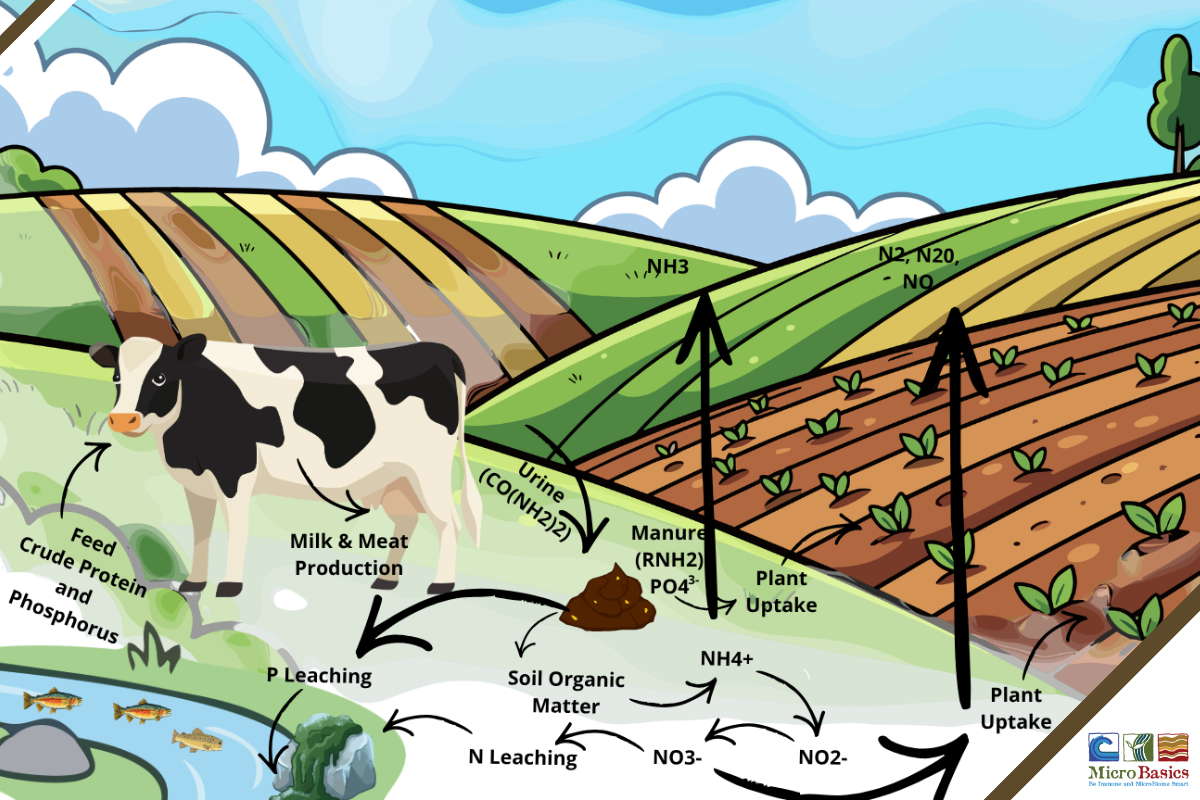
Nutrient management is one of the most powerful levers dairy producers have to improve profitability while protecting natural resources. Across Idaho’s dairy industry, especially in regions like the Magic Valley, managing nitrogen (N) and phosphorus (P) has become both an economic necessity and an environmental responsibility.
The Nutrient Imbalance Problem
Modern livestock production systems often bring more nutrients onto the farm than they export as saleable product. Nutrients come in the form of feed and leave as meat and/or milk. However, excess nutrients or those not absorbable by the animal are expelled on the ground in manure. Over time this can create a surplus of certain nutrients like N and P in the ground. This imbalance sets off a chain reaction of economic losses and environmental risks.
Economic Impacts: When Nutrients Become Costly Waste
1. Overfeeding = Lost Dollars
Feeding excess protein or phosphorus doesn’t improve production—but it does increase nutrient excretion.
- Higher crude protein diets significantly increase nitrogen losses, especially as volatile urinary nitrogen
- Phosphorus fed above requirements is largely excreted (up to ~70%). Although high phosphorus levels are not intentional, they can accompany diets containing high levels of byproduct feeds.
Producers are essentially paying for nutrients twice:
- Once when purchasing feed
- Again, when managing the excess in manure
2. Rising Land and Transport Costs
Managing excess nutrients requires more land.
- A balanced phosphorus diet may require ~1 acre per cow
- High-phosphorus diets can double that requirement
When land isn’t available, manure must be transported farther away—sometimes 8–14 miles—adding significant fuel, labor, and logistical costs.
3. Technology and Infrastructure Investments
Advanced manure separation systems and nutrient recovery technologies can improve efficiency—but they come with high upfront and operational costs.
Without incentives like cost-share programs or carbon credits, these technologies often struggle to “pencil out.”
4. Hidden Losses Through Inefficiency
Shrink, poor sampling, and imprecise application all contribute to lost value. Even small inefficiencies—like inaccurate manure nutrient estimates—can lead to over-application and wasted fertilizer potential.
Environmental Impacts: Beyond the Farm Gate
1. Water Quality and Eutrophication
Excess phosphorus runoff fuels algal blooms in water bodies like the Snake River, leading to eutrophication—dense plant growth that harms aquatic ecosystems and water usability.
Despite regulatory efforts (e.g., phosphorus limits in the Upper Snake River), targets are still not being met.
2. Groundwater Contamination
Nitrogen, especially in nitrate form, can leach into groundwater during irrigation or wet seasons. High post-harvest soil nitrogen levels—sometimes enough for multiple additional crops—highlight the scale of this risk.
3. Air Quality and Greenhouse Gas Emissions
Livestock operations are a major source of ammonia emissions in the U.S., with losses occurring at multiple stages:
- Housing (especially open lots)
- Storage
- Field application
These emissions contribute to:
- Air quality degradation
- Indirect greenhouse gas formation (nitrous oxide)
In fact, manure management alone accounts for nearly 29% of on-farm greenhouse gas emissions.
The Opportunity: Turning a Liability into an Asset
The good news? Nutrient management improvements often deliver both environmental and economic wins.
Feeding Strategies
Lowering crude protein and balancing amino acids (like lysine and methionine) improves nutrient efficiency while maintaining production. Additionally, additives, such as a synbiotic, enhance amino acid uptake in the small intestine improving N absorption.
Better Sampling and Timing
Frequent manure and soil testing allows producers to:
- Match application rates to crop needs
- Avoid costly over-application
Manure as a Resource
Manure isn’t just waste—it provides:
- Organic matter
- Micronutrients
- Soil health benefits
Recognizing and optimizing this value is key to long-term sustainability.
Integrated Management Systems
Whole-farm efficiency can be improved, and nutrient losses can significantly be reduced when combining the following strategies:
- Nutrition strategies
- Manure handling technologies
- Irrigation management
Final Thoughts
Nutrient management sits at the intersection of biology, economics, and environmental science. When done well, it reduces input costs, improves crop productivity, and protects vital natural resources. When ignored, it quietly drains profits and creates long-term risks.
The challenge—and opportunity—for today’s dairy producers is to treat nutrients not as waste to manage, but as assets to optimize.
Written by: Mariah Gull, M.S.
Source: College of Southern Idaho, Nutrient Management Workshop. Twin Falls, ID, March 2026.
Speakers:
Izabelle Teixeira, University of Idaho
April Leytem, retired USDA-ARS & Idaho Dairymen's Association
Megan Satterwhite, Idaho Dairymen's Association



Leave a comment
All comments are moderated before being published.
This site is protected by hCaptcha and the hCaptcha Privacy Policy and Terms of Service apply.