
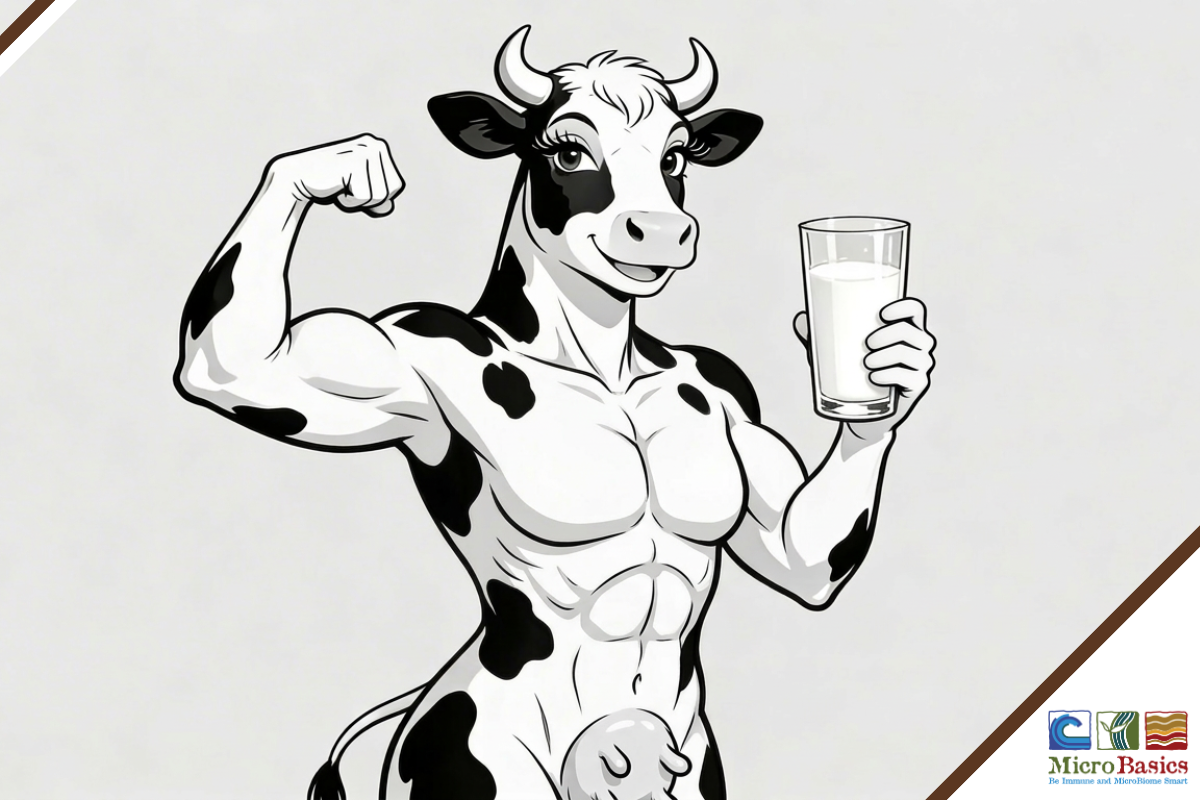
You might never have heard of a cow flexing her muscles before, but it may be more important than you think! When we think of dairy cattle we usually focus on large udders and milk veins, but there is evidence that we may want to focus on muscle mass more than we ever have before.
Metabolism
There are 3 main stores of tissue that are mobilized during the transition period.
- 1. Glycogen (primary short-term storage form of glucose)- mobilized quickly, small reserve.
- 2. Adipose (body fat)- usually the largest store of tissue, unless the animal is underconditioned.
- 3. Protein (mostly muscle, skin, and organs): the body does not store protein for future use. It must break down skeletal muscle to fuel protein needs. Protein mobilization from skeletal muscles can start as early as 5 weeks pre-calving, which is earlier than they will start to mobilize fat. This is mainly due to the increased need for amino acids in late gestation.
High Muscle vs. Low Muscle Animals
The industry has set guidelines for ideal body condition scores throughout each stage of lactation. New insight into muscular build encourages us to look beyond body condition score (BCS). Two cows may be the same BCS but have different amounts of fat and muscle.
Measuring muscle depth by ultrasound is not realistic for every heard but being away that thin-muscled cows are different risk category than solely "thin" cows is important.
Researchers have found several benefits shared by cows with greater amounts of muscle:
- - High muscled cows tended to have heavier calves with more muscle mass.
- - High muscled cows mobilize more muscle in comparison to their body weight than low muscled cows during the transition period.
- - High muscled cows make more milk most of the time.
Heifers vs. Primiparous Cows
There have been some differences noted in how heifers mobilize muscle during transition compared to mature cows. Findings include:
- - Heifers don't lose muscle until right before calving. They lose a smaller % of muscle compared to multiparous cows. Heifers tend to have higher insulin/glucose concentrations, which may be why they have less need to mobilize muscle.
- - In multiparous cows higher muscled cows tend to also be high muscle in their next lactation. These cows will end their lactation with less muscle than when they calved but will accrue more during the dry period.
How Can We Minimize Muscle Depletion?
Feeding strategies that increase metabolizable protein and amino acid supplies may be of greater importance than increasing dietary energy supply for fresh cows. Postpartum cattle have a greater capacity to mobilize fats versus protein, and we may not be providing enough.
Alternative feeding strategies may include feeding branched chain volatile fatty acids, rumen-protected amino acids, and/or direct-fed microbials (DFM).
Experts at UC Davis evaluated the effects of Achieve, a broad-spectrum DFM, on the plasma concentrations of both essential and non-essential amino acids. Cattle fed Achieve had higher levels of these amino acids when compared to control groups, and groups fed solely a yeast fermentation product.
Further research is needed; however, this feeding strategy is proving to be promising. Synbiotic products like Achieve enhance ruminal proteolysis and microbial protein synthesis. In turn increasing the flow of high-quality microbial protein and essential amino acids into the small intestine for absorption. Additionally, immune modulating components of Achieve reduce gut inflammation and pathogen load, decrease protein losses from the intestine and improving the efficiency of amino acid absorption across the lower gut mucosa.
In practical terms, this means Achieve could help cows maintain or improve milk protein yield, colostrum protein/Ig content, and immune function under transition stress. Not solely by feeding more crude protein, but by improving the fraction of dietary and microbial protein that is digested and absorbed as amino acids in the lower gut.
Written By: Mariah Gull, M.S.
Sources:
1. https://www.perplexity.ai/search/52a571d6-7b8f-455d-8d56-c5eab48fa96f
2. https://pmc.ncbi.nlm.nih.gov/articles/PMC11220247/
3. https://dairy.extension.wisc.edu/articles/water-a-critical-and-undervalued-nutrient-in-dairy-calves/
4. https://www.wvdl.wisc.edu/severe-colic-in-a-newborn-dairy-calf-caused-by-a-large-colostrum-curd-a-case-report/
5. https://pubmed.ncbi.nlm.nih.gov/37818390/
6. https://dairy.extension.wisc.edu/files/2024/05/Water-critical-undervalued-nutrient-dairy-calves.pdf
7. https://pubmed.ncbi.nlm.nih.gov/38962706/
8. https://www.frontiersin.org/journals/veterinary-science/articles/10.3389/fvets.2023.1240227/full
9. https://www.farmprogress.com/dairy-cattle/water-critical-undervalued-nutrient-in-dairy-calves
10. https://pmc.ncbi.nlm.nih.gov/articles/PMC7125574/
11. https://vet.ucalgary.ca/sites/default/files/teams/48/Lisa_3.pdf
12. https://pmc.ncbi.nlm.nih.gov/articles/PMC12126769/
13. https://www.sciencedirect.com/science/article/pii/S2666910225000134
14. https://www.sciencedirect.com/science/article/pii/S2666910224001145
15. https://www.sciencedirect.com/science/article/pii/S0022030225008501
16. https://pmc.ncbi.nlm.nih.gov/articles/PMC10881097/
17. https://onlinelibrary.wiley.com/doi/10.1111/jbg.70001
18. https://www.sciencedirect.com/science/article/pii/S0022030225007027
19. https://dairy.extension.wisc.edu/files/2024/05/Water-critical-undervalued-nutrient-dairy-calves.pdf
20. https://veterinaria.org/index.php/REDVET/article/view/526
21. https://pubmed.ncbi.nlm.nih.gov/30415859/

Leave a comment
All comments are moderated before being published.
This site is protected by hCaptcha and the hCaptcha Privacy Policy and Terms of Service apply.