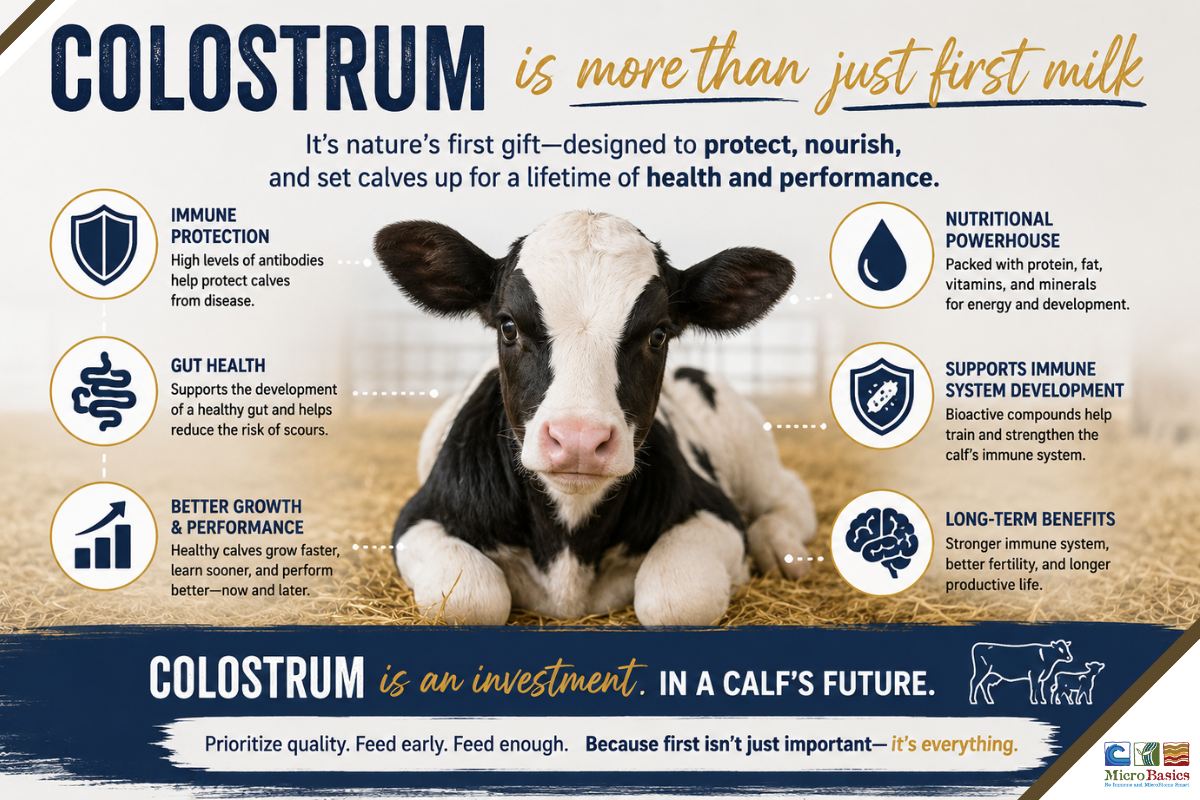
Colostrum is more than “first milk.” It is the newborn calf’s initial source of antibodies, energy, and bioactive compounds that support immunity and gut development. Both the amount produced and the composition matter.
For cattle producers, the challenge is that colostrum is not uniform from cow to cow or season to season. Research shows that colostrum yield and quality are influenced by environmental factors, prepartum nutrition, metabolic status, and management around calving and first milking.
Colostrum formation begins before calving, during the dry period with a large portion of that formation in the final weeks before parturition. Work in Holstein cows suggest the mammary gland changes its metabolism during this window, with acetate uptake rising about a week before calving and glucose uptake increasing at calving itself.
Timing helps explain why the dry period is so important. If the udder never truly “shuts down” or if the cow is under metabolic stress, the mammary gland may not reset normally, which can affect the next colostrum harvest.
Several prepartum factors are linked to how much colostrum a cow produces. Data summarized from 51 Holstein herds in Québec showed greater colostrum yield was associated with higher prepartum energy intake, lower dietary fiber, ash, calcium, magnesium, and iron, and with a longer dry period, especially around 65 days or more.
Cow metabolism also matters. In that same study, researchers found that both the cow’s energy balance and harvest timing can affect the total amount collected.
Previous lactation performance may play a role too. Fischer-Tlustos et. al reported that previous milk production and far-off mammary metabolism were negatively correlated with colostrum production, suggesting cows that stay highly metabolically active in the udder during the dry period may produce less colostrum later. Rest is important, even for the cells of the mammary gland! Let’s not forget that!
Colostrum quality is usually discussed in terms of IgG concentration, but it also includes fat, protein, solids, minerals, and bioactive compounds. Studies show that parity matters: primiparous cows often differ from multiparous cows in both yield and composition, second-parity cows may have lower colostral IgG than third-parity and older cows.
Timing matters as well. The longer the delay between calving and colostrum collection, the lower the IgG concentration tends to be, because colostrum is progressively diluted as transition milk starts to come in.
Nutrient supply before calving can also shift colostrum composition. Reviews and field studies indicate that prepartum diet composition, including energy, protein, vitamins, minerals, and feed additives, influences colostrum yield and quality.
Nutrition Studies Worth Noting
Colostrum is a hot topic, and several recent studies give practical clues about how nutrition affects production. Data collected from Eastern Canadian herds showed pre-calving diet and herd management explained a meaningful share of the variation in colostrum IgG and yield, but not all of it, which means colostrum remains partly unpredictable even with good management.
A University of New Hampshire study on nicotinic acid in prepartum Jersey cows found that 8 g/day improved colostrum IgG and 24-hour calf IgG, while 16 g/day was associated with better calf growth. Another study feeding nicotinic acid found no change in colostrum yield, but it did shift some composition measures such as fat and protein fractions, showing that the response may depend on dose, diet, and breed.
A look at feeding magnesium butyrate also showed altered colostrum composition and was linked with improved colostrum yield, IgG, protein, and lactose concentrations. Suggesting that adding more fuel for enterocytes may improve rumen function and volatile fatty acid/nutrient absorption.
That means a cow’s colostrum is not just a simple spillover from blood. It is the result of coordinated mammary uptake, immune transfer, and metabolic preparation before calving.
1. For cattle producers, the science points to a few clear priorities.
2. Maintain a well-managed dry period
3. Feed an appropriate close-up ration,
4. Avoid excessive delays before first milking.
Pay close attention to cow condition and metabolic health.
It also helps to remember that “more colostrum” is not always the same as “better colostrum.” The goal is enough volume, high IgG, good solids, and strong early calf intake so calves get both passive immunity and the nutrients they need to start well. Colostrum is not just a simple spillover from blood. It is the result of coordinated mammary uptake, immune transfer, and metabolic preparation before calving.
Written by: Mariah Gull, M.S.
Sources:
1. https://pubmed.ncbi.nlm.nih.gov/38246551/
2. https://pubmed.ncbi.nlm.nih.gov/40685125/
3. https://atrium.lib.uoguelph.ca/items/48e09c8c-fc8c-4f6f-86a2-32010dd40c25
4. https://scholars.unh.edu/thesis/2045/
5. https://pmc.ncbi.nlm.nih.gov/articles/PMC6940821/
6. https://www.sciencedirect.com/science/article/pii/S0022030220300801
7. https://pubmed.ncbi.nlm.nih.gov/41698592/
8. https://pubmed.ncbi.nlm.nih.gov/26898282/
9. https://pubmed.ncbi.nlm.nih.gov/30879822/
10. https://pubmed.ncbi.nlm.nih.gov/41274576/
11. https://www.journalofdairyscience.org/article/S0022-0302(24)00034-1/fulltext
12. https://www.sciencedirect.com/science/article/pii/S0022030225005405
13. https://pubs.rsc.org/en/content/articlehtml/2024/fb/d3fb00256j
14. https://pmc.ncbi.nlm.nih.gov/articles/PMC10266757/
15. https://pmc.ncbi.nlm.nih.gov/articles/PMC8300143/
16. https://pmc.ncbi.nlm.nih.gov/articles/PMC12397122/
17. https://dairy.extension.wisc.edu/articles/navigating-low-colostrum-yields-in-dairy-cows/
18. https://music.amazon.com/es-cl/podcasts/8f5e6b74-100d-4b1a-891d-ee95b467fccf/episodes/c6138c5b-d275-42b9-b8d0-4b0e8dd63896/real-science-exchange-dairy-adsa-winners---2025
19. https://www.journalofdairyscience.org/article/S0022-0302(19)30254-1/pdf
20. https://scholar.google.com/citations?user=l0Z_JJEAAAAJ&hl=en
21. https://www.sciencedirect.com/science/article/pii/S002203022602922X
22. https://www.journalofdairyscience.org/article/S0022-0302(24)01077-4/fulltext
23. https://www.journalofdairyscience.org/article/S0022-0302(76)84486-4/pdf
24. https://pmc.ncbi.nlm.nih.gov/articles/PMC11010951/
25. https://scholars.unh.edu/honors/867/
26. https://scholars.unh.edu/cgi/viewcontent.cgi?article=3810&context=dissertation
27. https://www.sciencedirect.com/science/article/pii/S0022030226001104


Leave a comment
All comments are moderated before being published.
This site is protected by hCaptcha and the hCaptcha Privacy Policy and Terms of Service apply.