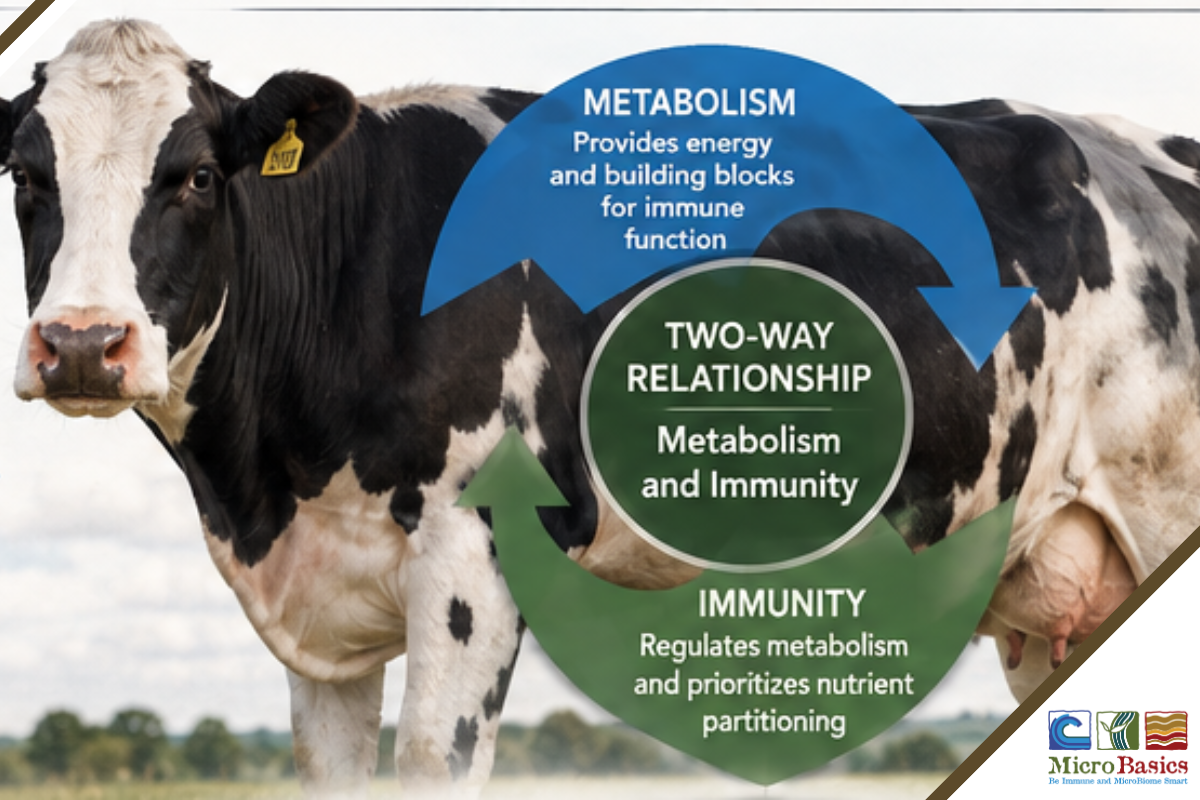
Nutrients do more than support maintenance, growth, milk production, and reproduction—they also fuel and regulate the immune system. Immunometabolism describes this two-way relationship between metabolism and immunity. Explaining why inflammation, stress, transition events, and gut health can have such meaningful effects on performance.
When a cow or calf faces a challenge, such as infection, heat stress, abrupt dietary change, or tissue damage, the body must decide where to direct its available resources. Nutrients that might otherwise support growth, milk synthesis, or reproduction can be reprioritized to activate immune cells, produce inflammatory signals, and restore normal function.
The immune system is often referred to as the body’s defense system. However, it also acts as a regulator of homeostasis, which is the stable internal environment needed for an animal to function normally. When that balance is disturbed, immune activation helps the animal respond and recover.
Immune response is necessary, but it comes with a cost. During inflammation, cytokines such as IL-1, IL-6, and TNF-α influence feed intake and nutrient partitioning. An activated immune system can shift nutrients away from productive functions and toward survival functions. This is one reason cattle dealing with disease, chronic stress, or excessive inflammation may show poorer gain, reduced feed efficiency, lower milk yield, or compromised reproductive performance.
Inflammation should not be viewed simply as “bad.” A controlled inflammatory response is essential for immune development, wound healing, and recovery. The objective is not to eliminate inflammation, but to support an appropriate response that resolves quickly and effectively rather than becoming prolonged or excessive.
The Transition Cow — an Immunometabolic Example
The transition from late gestation into early lactation is one of the clearest examples of immunometabolism. Around calving, cows undergo enormous metabolic, endocrine, and immune adjustments as nutrient demand rises sharply to support colostrum and milk production.
During this period, increased circulating fatty acids, reactive oxygen species, inflammatory cytokines, and cellular stress can affect the liver, mammary gland, adipose tissue, and immune cells. Loor and Elolimy describe how these signals can contribute to endoplasmic reticulum stress, mitochondrial dysfunction, inflammation, and altered insulin signaling in key tissues.
A certain degree of inflammatory activity around parturition is part of normal adaptation. However, prolonged or excessive inflammation is associated with important disorders such as metritis and mastitis. Transition cow management is more than an exercise in meeting energy requirements—it is also an effort to support a well-regulated immunometabolic response.
The Gut — a Major Control Point
The gastrointestinal tract sits at the intersection of nutrition, microbial metabolism, barrier function, and immune regulation. Gut microbes produce biologically active compounds that interact with intestinal cells and resident immune cells, making the microbiome an important contributor to immunometabolism.
In young calves, this relationship is especially important. Early microbial colonization helps train the developing immune system, while stressors such as poor nutrition, illness, or weaning can disrupt microbial balance. Dysbiosis happens when the gut microbiota become imbalanced. Intestinal barrier function and immune regulation may be affected, potentially increasing inflammatory signals beyond the gut.
For mature cattle, diets must support production without unnecessarily challenging rumen and intestinal health. High-grain feeding can be valuable for supplying energy, but overly aggressive grain inclusion relative to effective fiber can alter rumen microbial communities, lower rumen pH, and increase the risk of subacute ruminal acidosis. These changes may promote local and systemic inflammatory responses, affecting nutrient utilization, health, and performance.
Nutritional management cannot replace sound housing, ventilation, hygiene, colostrum management, vaccination, and disease prevention. However, it is an important lever for supporting immunometabolic resilience.
Key Focus Areas:
· Avoiding over- and undernutrition, particularly during late gestation and the transition period, because both can alter immune and metabolic adaptation.
· Providing balanced diets that support antioxidant defenses. Nutrients involved in glutathione production and antioxidant systems may help cells manage oxidative stress and regulate immunometabolic reactions.
· Protecting rumen function through appropriate forage, fiber effectiveness, ration consistency, feed access, and careful management of rapidly fermentable carbohydrates.
· Supporting calf gut development through excellent colostrum management, consistent milk or milk replacer feeding, clean water, starter intake, and minimizing avoidable stressors.
· Managing environmental challenges, including heat stress, because physiological stress can alter intake, metabolism, immune activity, and the microbiome.
Research also suggests that maternal nutrition may influence immunometabolic development of their offspring. For example, Loor and Elolimy reviewed work in which greater maternal methionine supply was associated with changes in calf liver immunometabolic networks, immune responsiveness, microbiota, and postweaning growth. These findings are promising, but they also reinforce that early-life nutrition may have effects extending beyond the immediate feeding period.
Takeaway
Immunometabolism reminds us that cattle performance is not determined by nutrition and health as separate systems. The immune system, liver, rumen, intestine, adipose tissue, mammary gland, microbiome, and endocrine system are continuously communicating.
For producers and consultants, the practical takeaway is straightforward: the most productive animal is not necessarily the one receiving the most nutrients, but the one able to use nutrients most efficiently while maintaining health and recovering quickly from challenges. Managing inflammation, supporting gut and rumen stability, reducing stress, and meeting nutrient requirements at critical life stages can help cattle devote more resources to productive outcomes.
⁂
1. https://pmc.ncbi.nlm.nih.gov/articles/PMC9564986/
2. https://academic.oup.com/af/article/12/5/13/6761290
3. https://www.mdpi.com/2079-6382/12/2/357
4. https://www.mdpi.com/2076-2615/12/16/2129
5. https://www.frontiersin.org/journals/immunology/articles/10.3389/fimmu.2026.1781797/full
6. https://www.ijvets.com/pdf-files/25-301.pdf
7. https://web.pkusz.edu.cn/huoyq/files/2018/06/29328913.pdf
8. https://europepmc.org/article/med/36268177
9. https://academic.oup.com/af/article/12/5/8/6761284
10. https://pubmed.ncbi.nlm.nih.gov/36268165/
11. https://academic.oup.com/af/article/12/5/11/6761283
12. https://academic.oup.com/af/article/12/5/3/6761281
13. https://pubmed.ncbi.nlm.nih.gov/36268177/
14. https://dr.lib.iastate.edu/bitstreams/d386bb13-bc14-4ab6-97a7-da6b8b2b3400/download
https://pdfs.semanticscholar.org/5e69/c685918f979c52970b68c7a3c5768bf579aa.pdf


Leave a comment
All comments are moderated before being published.
This site is protected by hCaptcha and the hCaptcha Privacy Policy and Terms of Service apply.